The normal-technology, power/empire, existential-risk, and bubble camps now produce distinct engineering and policy programs.
Introduction to AI Ethics
ANI, AGI, and the moral landscape
What kind of thing is AI—and who gets to say?
We begin by refusing the idea that an AI system is only a model. Students map the stories shaping AI discourse, locate values in technical choices, and use four ethical frameworks on the same cases.
Join the live room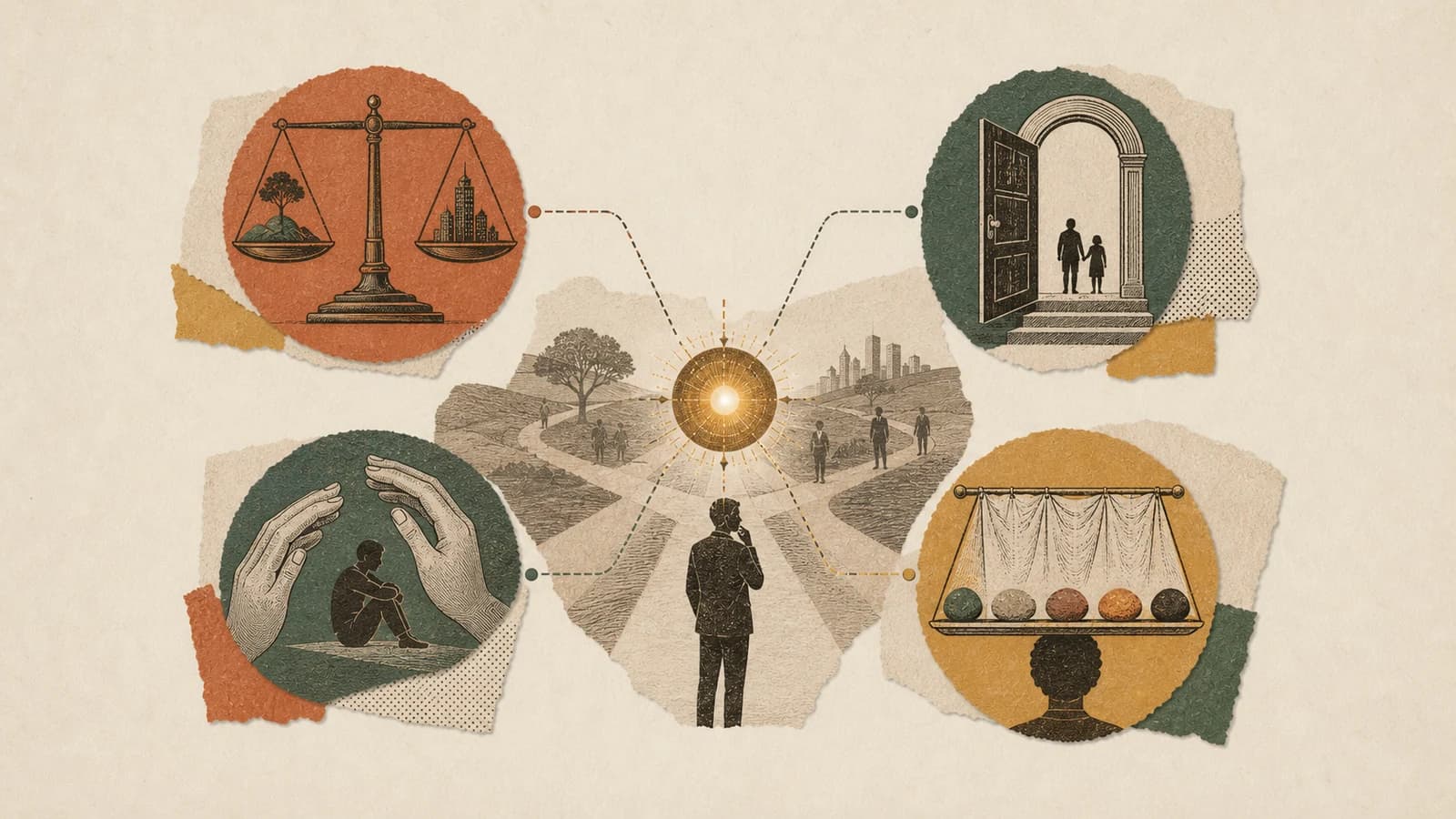
Before class
Read one narrative camp charitably. Bring one current AI headline and a two-sentence account of the policy your author would derive from it.
After class
Write the seminar charter in your own words: one norm you expect to find easy, one you expect to find difficult, and how the room should hold you to it.
The promise
By the end of this room…
- 01Distinguish a technical artifact from the socio-technical system around it.
- 02Identify how cultural narratives change the policy derived from the same evidence.
- 03Apply consequentialist, deontological, virtue, and justice-based reasoning.
- 04Separate fairness, accountability, transparency, privacy, and safety as operational questions.
- 05Read a canonical AI case against its primary evidence rather than its headline.
Why this week now
Signals, not scene-setting.
The state is no longer only regulating systems; EO 14319 turns a definition of ideological neutrality into procurement policy.
Stanford's 2026 evidence records rising incident counts while model transparency remains weak.
Run of show
Provoke → frame → work → argue → synthesize.
- 0:00provocation
One word, then four corners
Students submit one word for AI, then commit to the narrative camp closest to their current view: normal technology, empire, existential risk, or bubble.
Deliverable · A room map we photograph and revisit in Week 13.Live activity · narrative camp - 0:15frame
The model is not the system
Definitions in tension; the socio-technical layer model; the neutrality fallacy; and the course's recurring move from an output to the institution that made it consequential.
- 0:45discussion
One headline, four policies
Pairs receive the same current headline, identify its implicit narrative, and state the policy each camp would derive from it.
Deliverable · A 100-word pair post with one evidence link.Live activity · headline policy - 1:10frame
Ethics as engineering questions
Consequences as a loss function, duties as hard constraints, virtue as institutional habit, and Rawlsian justice as a distributional stress test.
- 1:35break
Break
Ten minutes. Leave the room's unresolved question visible.
- 1:45forensics
Framework speed-dating
Four groups run one assigned framework across COMPAS, Gender Shades, Uber ATG, and the Air Canada chatbot, then apply it to one shared current case.
Deliverable · A framework card: duty, evidence, affected party, action, blind spot.Live activity · framework friction - 2:25controversy
Can neutrality be specified?
Assigned sides debate whether the federal procurement order is bias mitigation, switch sides, then draft a defensible neutrality test—or explain why one cannot exist.
Live activity · neutrality sac - 2:50synthesis
What would move you?
Ratify the seminar norms and name the evidence that could move you out of your opening narrative camp.
Live activity · week 1 exit
Case room
Evidence before opinion.
COMPAS
Which definition of fairness is hiding inside the headline?
Gender Shades
Who disappeared inside aggregate accuracy?
Uber ATG
Where did meaningful control actually sit?
Air Canada chatbot
Can a deployer disclaim the system through which it speaks?
EO 14319
Can the state operationalize ideological neutrality without choosing an ideology?
Reading stack
Read the tension, not the bibliography.
- 01CoreDo Artifacts Have Politics? ↗
Langdon Winner
- 02CurrentAI as Normal Technology ↗
Arvind Narayanan & Sayash Kapoor
- 03CurrentResponsible AI — AI Index 2026 ↗
Stanford HAI
- 04ReferenceRecommendation on the Ethics of AI ↗
UNESCO
Evidence ledger
Every case has a receipt.
10 primary, scholarly, or first-party sources
Updated definition of an AI system
A functional definition built around inputs, inferred outputs, objectives, autonomy, and adaptiveness.
Definition & policy note ↗Artificial Intelligence Risk Management Framework 1.0
The primary source for Govern–Map–Measure–Manage and lifecycle risk ownership.
Risk-management framework ↗Recommendation on the Ethics of Artificial Intelligence
Connects AI governance to dignity, rights, justice, diversity, participation, and remedy.
International recommendation ↗
AI as Normal Technology
Narayanan and Kapoor argue that AI can be transformative while remaining governable as a normal technology.
Current argument ↗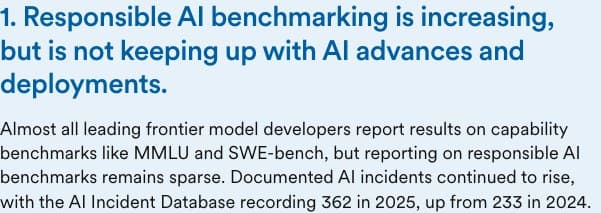
AI Index 2026 — Responsible AI
Current evidence on AI incidents, transparency, evaluations, and institutional accountability.
Evidence report ↗
Preventing Woke AI in the Federal Government
A live case in the state defining ideological neutrality and bias for procured language models.
Executive order ↗Moffatt v. Air Canada, 2024 BCCRT 149
The primary record for a company being held to information delivered by its customer-service chatbot.
Tribunal decision ↗
How we analyzed the COMPAS recidivism algorithm
The evidence and cohort construction behind the canonical COMPAS fairness dispute.
Investigative methodology ↗Gender Shades: Intersectional Accuracy Disparities
The foundational intersectional audit of commercial gender-classification systems.
Peer-reviewed audit ↗Tempe automated vehicle crash investigation
An official record for tracing harm across perception, interface, operations, oversight, and organization.
Safety investigation ↗