Fairness disputes increasingly reach courts and regulators through workflows, vendor roles, and adverse effects—not through a single accepted metric.
Algorithmic Fairness
Mathematical definitions of justice
Can justice be a constraint you optimize under—and who chooses the constraint?
The class computes competing fairness metrics on the same decisions, sees why several cannot hold together, and treats metric selection as a public-policy choice rather than a purely technical fix.
Join the live room
Before class
Complete the short confusion-matrix worksheet and bring a 400-word memo answering: which error should a hiring screen treat as most serious, and why?
After class
Revise your memo after the impossibility result. Name the metric you would choose, the duty it serves, and the recourse required for people it disadvantages.
The promise
By the end of this room…
- 01Compute and explain demographic parity, equal opportunity, equalized odds, calibration, and predictive parity.
- 02State the conditions that create fairness impossibility results.
- 03Connect each metric to the stakeholder and harm it prioritizes.
- 04Separate measurement uncertainty from normative disagreement.
- 05Design a decision and appeal process around a selected metric.
Why this week now
Signals, not scene-setting.
Generative and ranking systems make the outcome space less tidy, but the normative choice of who bears error remains.
A metric without an appeal route can make disparity legible while leaving affected people powerless.
Run of show
Provoke → frame → work → argue → synthesize.
- 0:00provocation
Choose your error
Students choose which error a high-stakes screening system should equalize before seeing the group's base rates or stakeholder roles.
Live activity · choose error - 0:15frame
The metric is a moral commitment
Confusion matrices, base rates, thresholds, calibration, demographic parity, error parity, and the different social worlds each metric assumes.
- 0:45discussion
Metric stations
Groups calculate a different fairness condition on one shared decision table, then translate the number into who gains, who waits, and who bears error.
Live activity · metric choice - 1:10frame
Why fairness goals collide
Chouldechova and Kleinberg impossibility results, followed by a practical move: from 'make it fair' to an accountable choice with evidence and recourse.
- 1:35break
Break
Ten minutes. Leave the room's unresolved question visible.
- 1:45forensics
COMPAS evidence room
Groups reconstruct the ProPublica/Northpointe dispute from the underlying cohort, outcomes, and metrics before writing any moral conclusion.
Deliverable · Claim → metric → evidence → affected party → limitation.Live activity · compas finding - 2:25controversy
ProPublica v. Northpointe
Structured academic controversy: defend one metric, switch sides, then recommend a decision rule and an appeal route for an institution—not a benchmark.
Live activity · fairness recommendation - 2:50synthesis
The sentence behind the number
Complete: 'We chose this metric because the institution has a stronger duty to prevent…'
Live activity · week 3 exit
Case room
Evidence before opinion.
COMPAS
Can both sides be statistically correct and normatively opposed?
Mobley v. Workday
Who owns disparity when a vendor participates in screening at scale?
Equalized odds
Whose error does this metric treat as the governing harm?
Reading stack
Read the tension, not the bibliography.
- 01CoreFair prediction with disparate impact ↗
Alexandra Chouldechova
- 02CoreInherent Trade-Offs in the Fair Determination of Risk Scores ↗
Kleinberg, Mullainathan & Raghavan
- 03CurrentHow we analyzed COMPAS ↗
ProPublica
- 04ReferenceMobley v. Workday court order ↗
N.D. California
Evidence ledger
Every case has a receipt.
5 primary, scholarly, or first-party sources

How we analyzed the COMPAS recidivism algorithm
The evidence and cohort construction behind the canonical COMPAS fairness dispute.
Investigative methodology ↗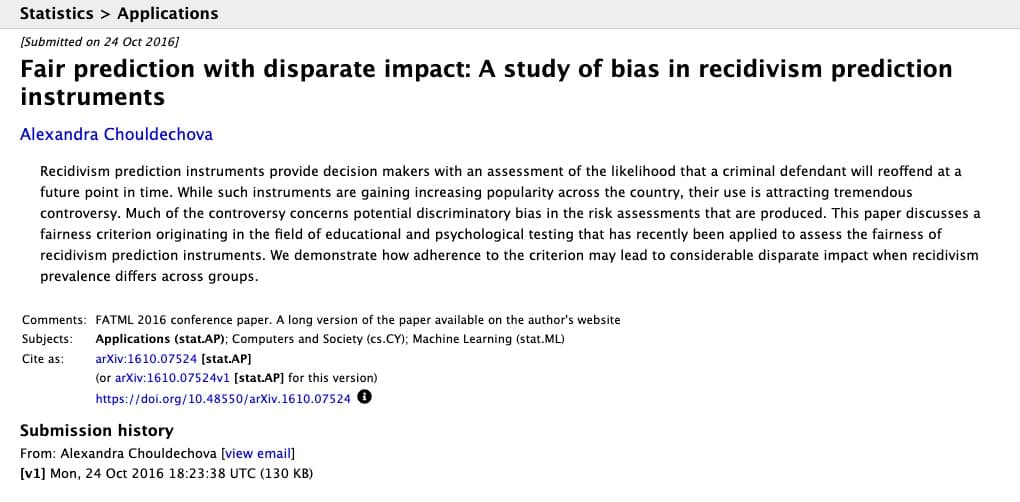
Fair prediction with disparate impact
A formal demonstration that common fairness criteria can conflict when group base rates differ.
Peer-reviewed article ↗Inherent Trade-Offs in the Fair Determination of Risk Scores
A second route to the impossibility result: calibration and error-balance conditions cannot generally all hold.
Fairness theorem ↗Equality of Opportunity in Supervised Learning
Introduces equalized odds and equality of opportunity as measurable constraints on prediction error.
Research paper ↗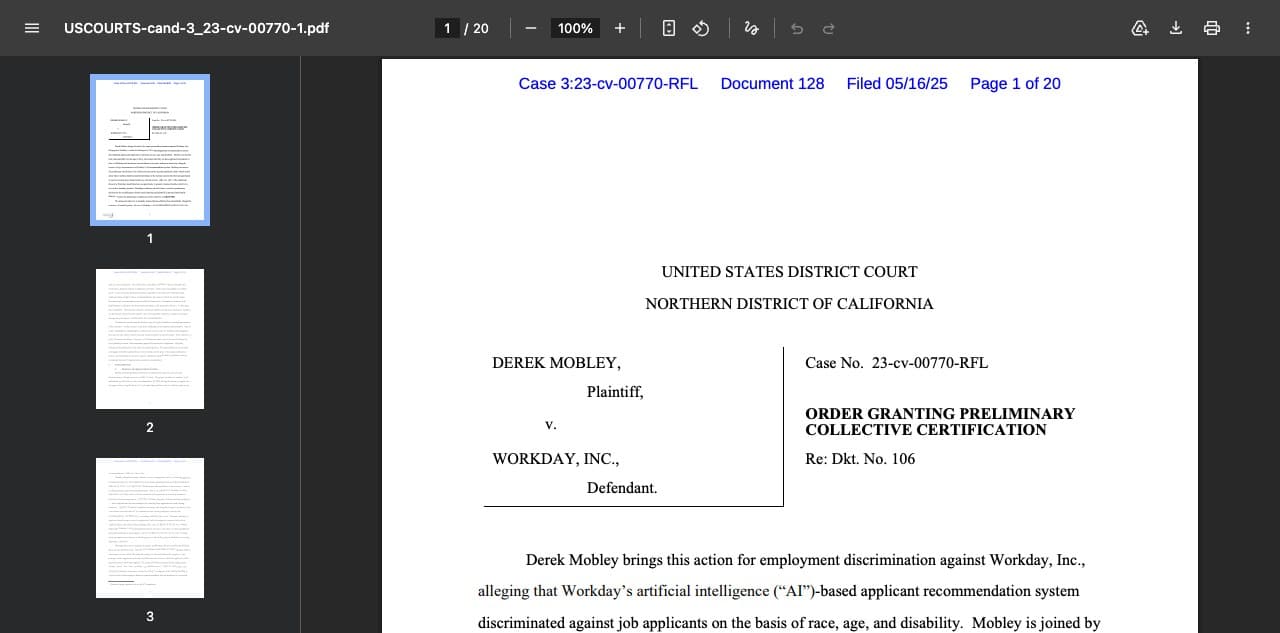
Mobley v. Workday — preliminary collective certification
A live employment-discrimination case about when an AI vendor materially participates in consequential decisions.
Court order ↗