The central question has moved from enactment to implementation, standards, institutional capacity, litigation, and rollback.
AI Policy & Governance
The race to regulate and future directions
Can governance keep up without becoming either theatre or a brake controlled by incumbents?
Students compare the EU risk-based regime, U.S. executive and state approaches, international safety coordination, standards, procurement, enforcement, and institutional capacity.
Join the live roomBefore class
Map your capstone system to the EU AI Act and one non-EU governance instrument. Flag every claim that depends on implementation guidance.
After class
Write the one-page communiqué from your delegation and name the concession that made agreement possible.
The promise
By the end of this room…
- 01Map an AI use to a regulatory obligation and enforcement institution.
- 02Compare risk regulation, transparency duties, liability, standards, and procurement.
- 03Apply Collingridge's dilemma and the Brussels Effect to current evidence.
- 04Negotiate governance under geopolitical and capacity constraints.
Why this week now
Signals, not scene-setting.
The U.S. federal approach is built heavily through executive action, procurement, infrastructure policy, and conflict with states.
International safety reports can create a shared evidence base without resolving competing interests or enforcement authority.
Run of show
Provoke → frame → work → argue → synthesize.
- 0:00provocation
Commit before the concepts
Which governance instrument is most likely to change an AI product in practice?
Live activity · week 12 opening - 0:15frame
The comparative governance map
The central question has moved from enactment to implementation, standards, institutional capacity, litigation, and rollback.
- 0:45discussion
Reading tension
Student leaders present the assigned readings as a clash of defensible positions, then moderate questions that expose the hidden assumptions.
- 1:10frame
Enforcement is the product
The U.S. federal approach is built heavily through executive action, procurement, infrastructure policy, and conflict with states.
- 1:35break
Break
Ten minutes. Leave the room's unresolved question visible.
- 1:45forensics
EU AI Act implementation stress test
Role-based groups work the anchor case through technical, legal, stakeholder, and normative lenses.
Deliverable · A two-minute finding with evidence, uncertainty, and an actionable remedy.Live activity · week 12 forensics - 2:25controversy
Global AI Accord six-delegation simulation
Assigned positions, side-switch, and a joint recommendation that names the value or stakeholder it leaves exposed.
Live activity · week 12 controversy - 2:50synthesis
Re-vote and leave a trace
Repeat the opening vote, inspect what moved, and submit the strongest argument you still reject.
Live activity · week 12 exit
Case room
Evidence before opinion.
EU AI Act
What must exist institutionally for a risk-based law to operate?
America's AI Action Plan
Which values are operationalized through procurement and infrastructure?
International AI Safety Report
What can a shared evidence process coordinate without legal force?
Reading stack
Read the tension, not the bibliography.
- 01CurrentAI Act regulatory framework ↗
European Commission
- 02CurrentAmerica's AI Action Plan ↗
The White House
- 03CurrentInternational AI Safety Report 2026 ↗
International expert panel
Evidence ledger
Every case has a receipt.
4 primary, scholarly, or first-party sources
AI Act regulatory framework and implementation timeline
The Commission's primary overview of the EU AI Act, risk tiers, and phased application.
Regulatory overview ↗Winning the Race: America's AI Action Plan
A primary source for the current U.S. federal emphasis on infrastructure, innovation, procurement, and geopolitical competition.
Government plan ↗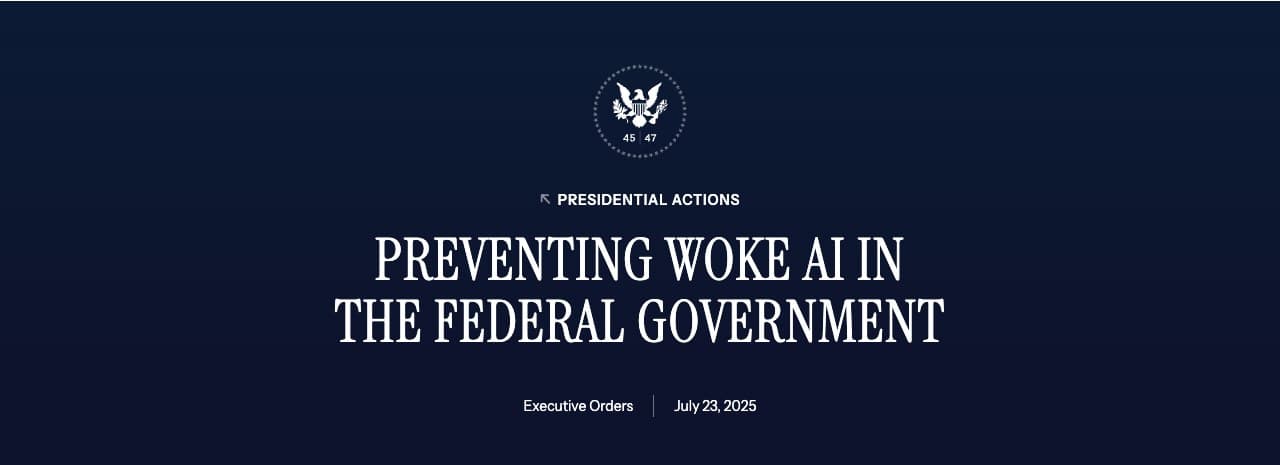
Preventing Woke AI in the Federal Government
A live case in the state defining ideological neutrality and bias for procured language models.
Executive order ↗International AI Safety Report 2026
A shared technical evidence base for frontier capabilities, risks, safeguards, and uncertainty.
International evidence synthesis ↗