Agentic and companion systems make purpose, output, and user interaction less fixed while organizational duties remain.
Responsibility & Accountability
The crisis of agency and the problem of many hands
When everyone touched the system, who is answerable for what it did?
Students trace causal contribution, knowledge, control, duty, liability, and remedy across vendors, deployers, operators, executives, and regulators.
Join the live roomBefore class
Choose one AI failure and diagram who had knowledge, control, duty, and capacity to prevent or repair it.
After class
Convert the blame map into an accountability design: owner, monitor, stop authority, notification, and remedy.
The promise
By the end of this room…
- 01Distinguish causal, role, moral, and legal responsibility.
- 02Build a blame stack across an AI supply chain.
- 03Identify moral crumple zones and responsibility gaps.
- 04Design authority, escalation, incident response, and remedy before deployment.
Why this week now
Signals, not scene-setting.
Courts increasingly ask whether vendors materially participated in decisions rather than accepting a clean developer/deployer split.
Human oversight is empty when the human lacks time, information, authority, or a credible stop path.
Run of show
Provoke → frame → work → argue → synthesize.
- 0:00provocation
Commit before the concepts
When an AI-assisted decision causes harm, who should carry the largest share of responsibility?
Live activity · week 5 opening - 0:15frame
The many hands problem
Agentic and companion systems make purpose, output, and user interaction less fixed while organizational duties remain.
- 0:45discussion
Reading tension
Student leaders present the assigned readings as a clash of defensible positions, then moderate questions that expose the hidden assumptions.
- 1:10frame
Meaningful control and the blame stack
Courts increasingly ask whether vendors materially participated in decisions rather than accepting a clean developer/deployer split.
- 1:35break
Break
Ten minutes. Leave the room's unresolved question visible.
- 1:45forensics
Dual blame stack: chatbot harm and automated vehicle failure
Role-based groups work the anchor case through technical, legal, stakeholder, and normative lenses.
Deliverable · A two-minute finding with evidence, uncertainty, and an actionable remedy.Live activity · week 5 forensics - 2:25controversy
In re Companion AI tribunal
Assigned positions, side-switch, and a joint recommendation that names the value or stakeholder it leaves exposed.
Live activity · week 5 controversy - 2:50synthesis
Re-vote and leave a trace
Repeat the opening vote, inspect what moved, and submit the strongest argument you still reject.
Live activity · week 5 exit
Case room
Evidence before opinion.
Uber ATG
Where did safety authority sit before the crash?
Air Canada chatbot
Why did the deployer remain answerable for the channel it created?
Mobley v. Workday
When does a vendor become an agent in a consequential decision?
Reading stack
Read the tension, not the bibliography.
- 01CoreMoral Crumple Zones ↗
Madeleine Clare Elish
- 02CurrentMoffatt v. Air Canada ↗
BCCRT
Evidence ledger
Every case has a receipt.
4 primary, scholarly, or first-party sources
Moral Crumple Zones: Cautionary Tales in Human-Robot Interaction
Explains how responsibility can collapse onto a nearby human despite distributed system control.
Scholarly article ↗Tempe automated vehicle crash investigation
An official record for tracing harm across perception, interface, operations, oversight, and organization.
Safety investigation ↗Moffatt v. Air Canada, 2024 BCCRT 149
The primary record for a company being held to information delivered by its customer-service chatbot.
Tribunal decision ↗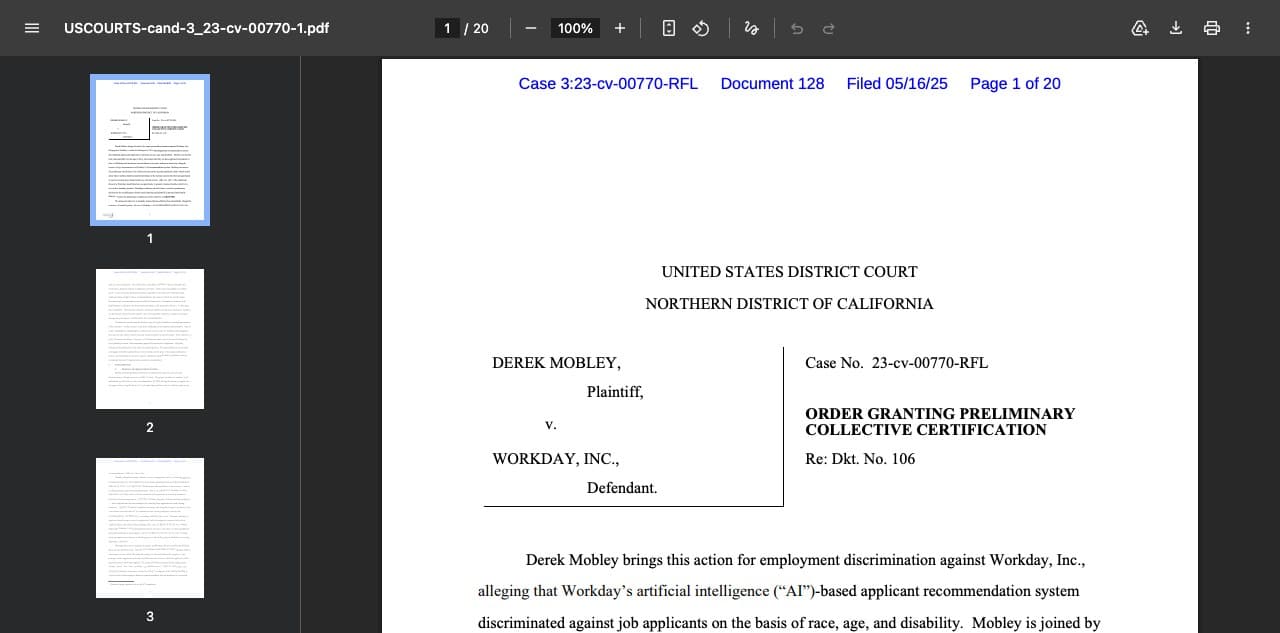
Mobley v. Workday — preliminary collective certification
A live employment-discrimination case about when an AI vendor materially participates in consequential decisions.
Court order ↗